Choosing
Judging an agent on what you can verify
Basetao has sixteen reviews spread across two profiles, and the review platform prints its own warning about the sample. Here is what to read instead, and what it says.
Reputation
The review evidence, and why it settles nothing
Start with the thing most guides lead with, because it is worth explaining why it is useless here rather than quietly skipping it.
Basetao has two separate profiles on the same review platform. One is filed under an older domain that now redirects to the current site, scores 3.3, and holds eleven reviews, two of them from the last year. The other is filed under the current domain, scores 4.1, and holds five. Neither profile has been claimed by the company. The platform adds its own note to the page: the company has never invited customers, so the reviews may not be representative.
Sixteen reviews cannot support a conclusion in either direction. Not it is bad
, and not the 4.1 is the real one
. The agents it gets compared with have hundreds or thousands, which is the only reason that comparison is shown below at all.
| Agent | Score | Reviews |
|---|---|---|
| Basetao (two profiles) | 3.3 and 4.1 | 11 and 5 |
| JoyaGoo | 4.6 | 3K |
| Superbuy | 4.5 | 1K |
| Acbuy | 4.5 | 973 |
| CSSBuy | 4.2 | 724 |
| SUGARGOO | 3.4 | 642 |
| Kakobuy | 4.2 | 315 |
| GTBUY | 4.2 | 30 |
Why there is no ranking on this page
A ranking has to be defensible, and the things people most want ranked are service, speed and whether an agent will take your money and vanish. There is no reproducible public data for any of those. Scoring them would mean inventing numbers and presenting them as findings. What is on this page instead are single facts with a source and a date, and the judgement is left where it belongs.
What to read instead
Five things you can check for yourself
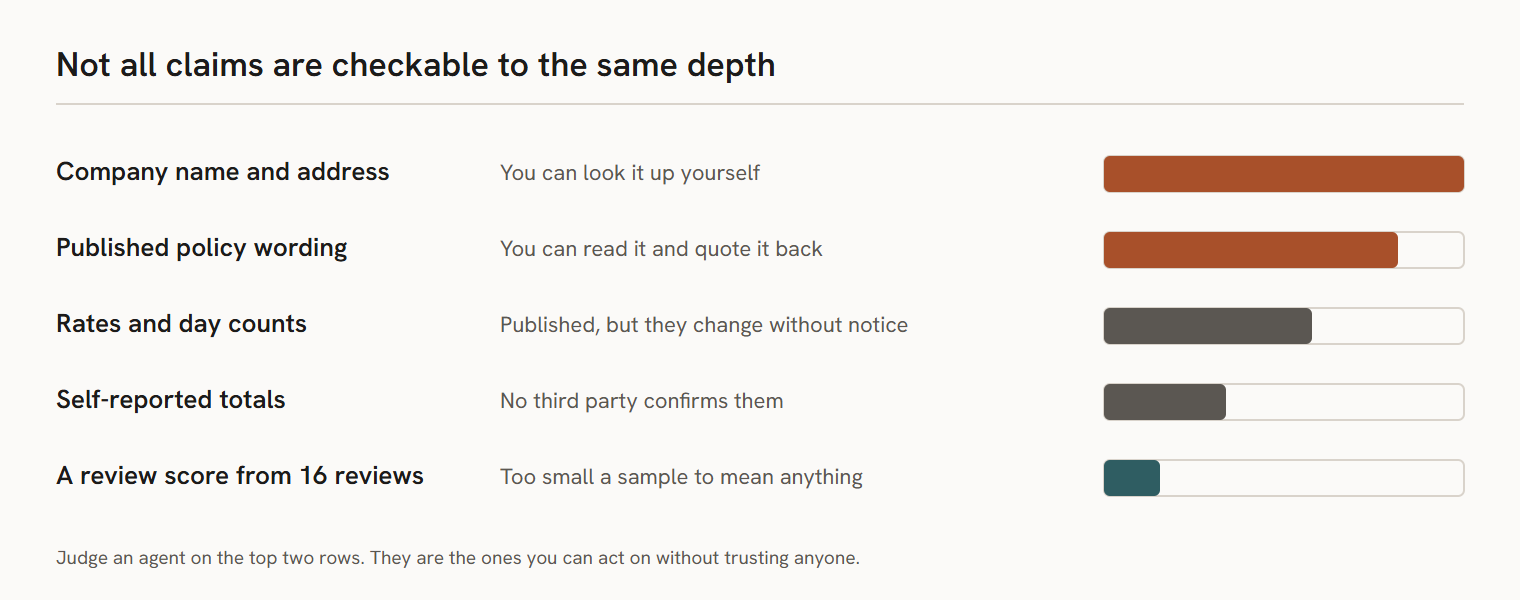
Five things can be checked without trusting anybody. In rough order of how much they tell you:
A registered company, with an address
Basetao publishes three entity names across two jurisdictions, with street addresses and a phone number, on its privacy page. You can look them up. An agent that cannot be traced to a legal entity is a different risk category entirely, and plenty cannot.
Policies that name their own exclusions
The inspection page says in writing that colour accuracy and real measurements are outside its scope, and that electronics are checked only from the outside. Marketing copy never volunteers that. A policy that lists what it will not do is more trustworthy than one that promises everything.
Numbers with a unit attached
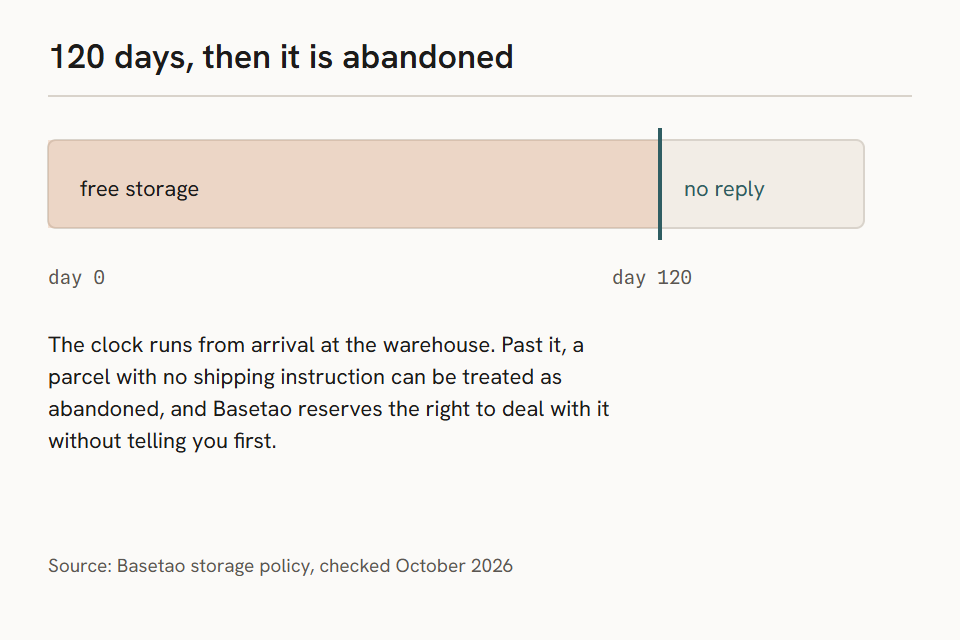
120 days of free storage. Insurance at 2% and 4%. A payout table with five rows. Seven days for a seller's return window. These are specific enough to argue with, which means they are specific enough to rely on until the page changes.
Internal consistency
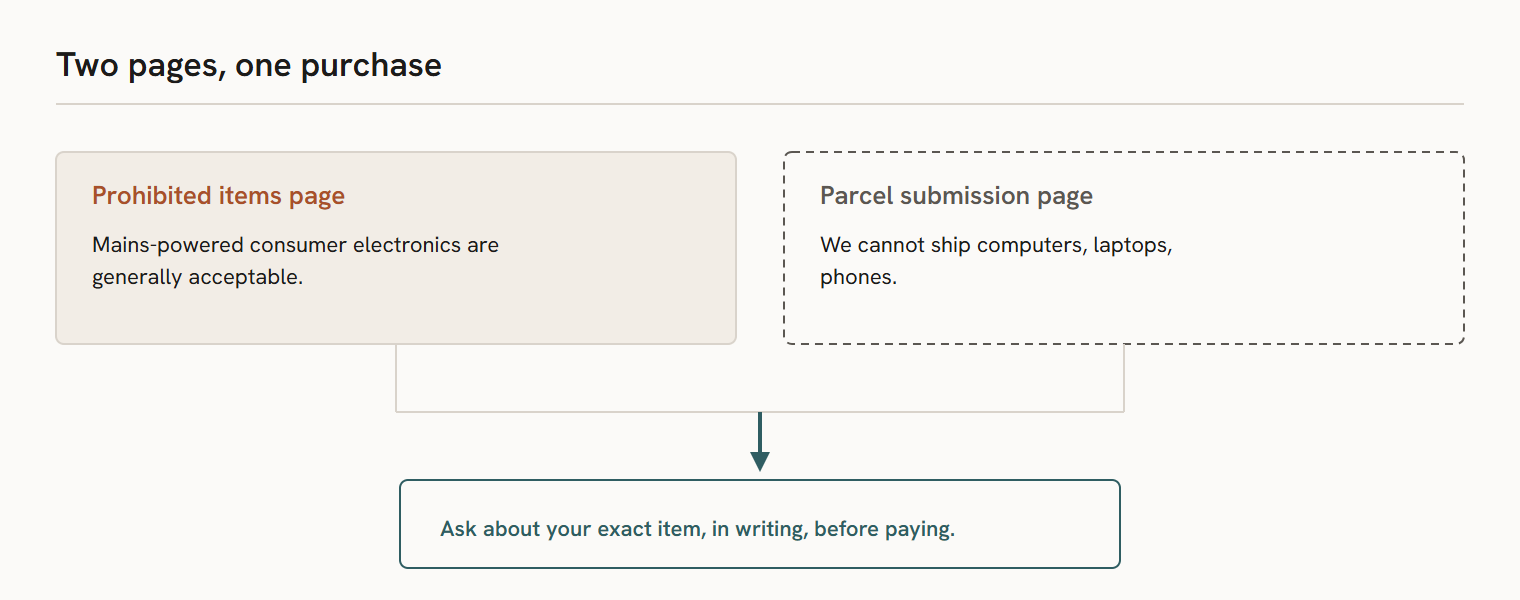
This is where Basetao is weakest, and it is worth knowing before you order rather than after. Two pages disagree about whether consumer electronics can ship. The prohibited items page argues entirely from American law while the parcels leave China.
Whether the published pages are maintained
All of the above moved to new addresses in 2026 with no redirects, and a heading on one page still carries a typo. Treat the terms as current only on the day you read them.
This agent
Where Basetao is genuinely different
Most of what any agent does is the same as what every other agent does. They buy on your behalf, consolidate, photograph, and hand the parcel to a carrier. Comparing them on that is comparing them on nothing. Three things about Basetao are actually distinguishing, and one of them is a reason to go elsewhere.
The storage window is long and the number is published
120 free days is generous by the standards of this market, and it is the single most useful thing here if you buy across several weeks and ship once. The terms around it are blunt about what happens afterwards, which is the right way round.
The payout table is itemised
Five situations, three insurance levels, percentages in each cell. Whether the percentages are good is a separate question, but an itemised table lets you reason about a specific loss instead of hoping.
Payment options are unusually wide
Ten methods are listed, including several European bank-transfer systems that agents often skip. If card payments to Chinese merchants are a problem for you, this is a real differentiator.
When to use someone else
If you are buying anything liquid, powdered, or battery-powered, the refusal lists here are strict and the two pages contradict each other, which makes planning hard. If your order is mostly electronics, start by asking support in writing and be ready to go elsewhere. And if you want to judge an agent by a large body of customer reviews before committing, Basetao simply does not have one, and no amount of reading this page will change that.
The wider field
Three things true of shopping agents generally
Knowing roughly how the field is shaped makes any single agent easier to read. Three facts about the market generally, none of them specific to Basetao:
They mostly resell the same platforms. Taobao, Tmall, 1688 and JD are the usual sources, so the item you are buying is often identical across agents. What differs is the service layer: consolidation, inspection detail, storage terms, which lines they have contracts on.
The real cost is rarely the service fee. It is split between the exchange rate applied to your payment and the shipping line you end up on. An agent advertising no service fee can still be the expensive option, and the only way to tell is to price a real parcel on each.
Policy documents get copied between brands. The same clauses, sometimes the same sentences, turn up across unrelated agents because they run similar back-office software. That is worth knowing for two reasons: an impressive-sounding policy may not be this company's own work, and a page can describe a jurisdiction nobody here operates in, which is exactly what happened to the prohibited items list.
None of that tells you which agent to use. It tells you which questions actually separate them.