
Shipping limits
What stops a parcel before it reaches you
Two official refusal lists that do not agree, a prohibited items page argued from US law, and a size rule that catches people out. Sorted by which of the three parties actually decides.
Three parties
The three points where a parcel gets stopped
A parcel can be stopped three times on one journey, by three different parties, for three unrelated reasons. Most of the confusion about what an agent can ship comes from treating these as one rule.
- CN China export side
- CA Carrier
- DE Destination side
- CN
China export side
Basetao's own prohibited list and Chinese export rules. This is the only one of the three that Basetao decides.
depends - CA
The carrier
A second, shorter refusal list from the page you submit a parcel on, plus volumetric weight and the 1.5 m size limit.
depends - DE
Destination side
Your own customs and tax office. Basetao publishes nothing about this, and says duty is the recipient's.
blocked
The third segment is marked as a stop on purpose
Basetao clears the China side and tells you plainly that duty and clearance at the other end are yours. Nothing on its site describes what your country lets in. So for the purposes of planning a parcel, treat that segment as unresolved until you have checked it yourself.
Two lists
What the two official lists each refuse
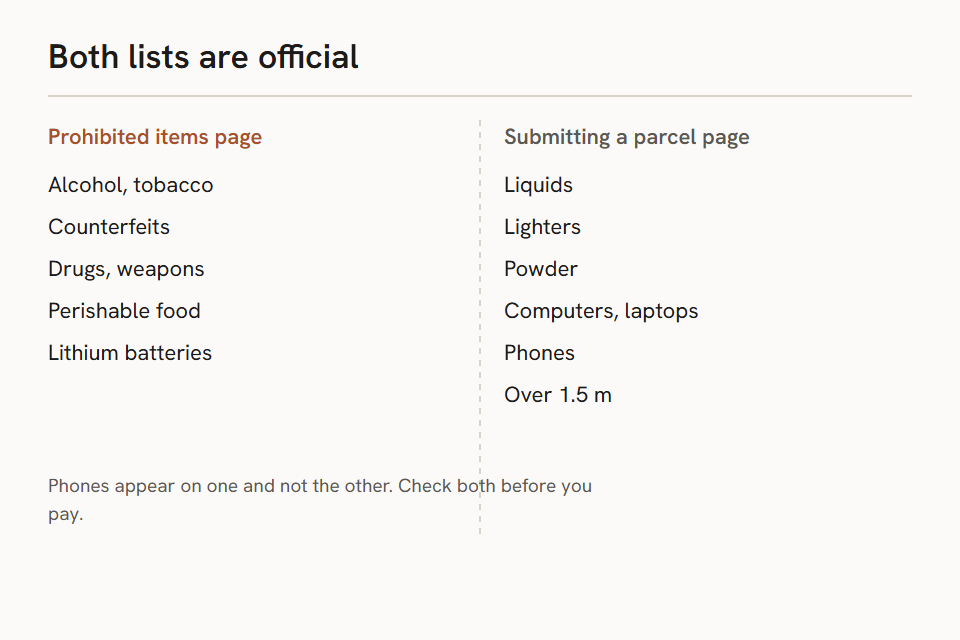
There are two official refusal lists, on two pages, and they are not the same list. The prohibited items page is the long one, organised into fourteen categories. The page you use to hand a parcel over is the short one, and it is blunter.
The short list names: gun-shaped products, liquids, lighters, powder, computers, laptops, phones, loose batteries, and anything longer than 1.5 m. Several of those are not obvious from the long list, and one of them contradicts it outright.
- CAThe carrier's refusal list
We cannot ship gun-shaped products, liquids, lighters, powder, computers, laptops, phones, loose batteries, or items longer than 1.5 m.
Submitting a parcel, checked October 2026
- CNCounterfeits, on the prohibited list
The US government protects company brands and their products by making it illegal to sell, trade, or ship counterfeit or otherwise infringing knockoff items.
Prohibited items, checked October 2026
Whose rules
A prohibited items page written for a different country
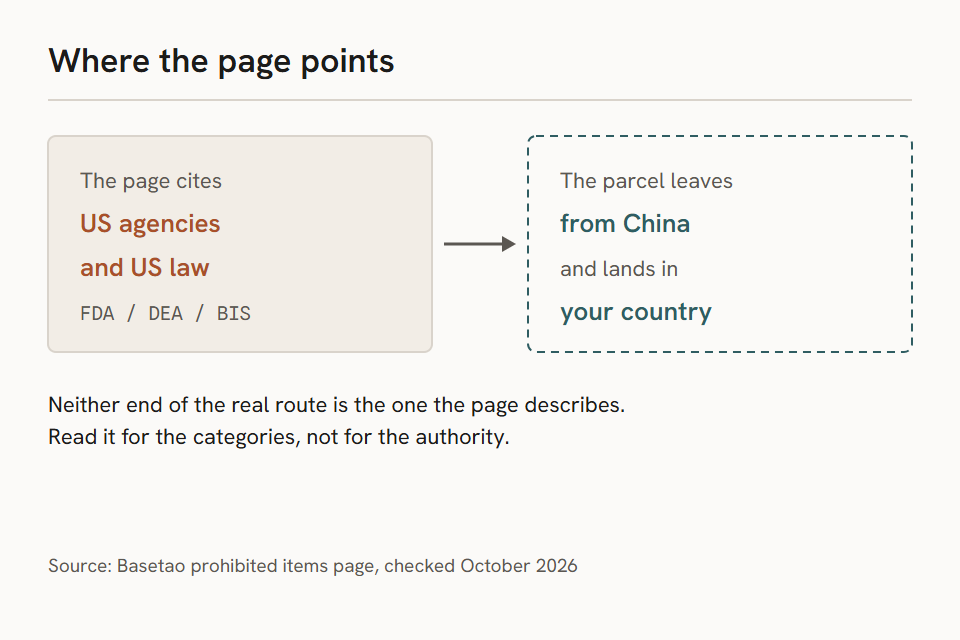
The prohibited items page has a stranger problem than its gaps. Every authority it cites is American. It sends you to the US Fish and Wildlife Service for animal products, the DEA's Controlled Substances Act for chemicals, the Commerce Control List for export-controlled electronics, and the FDA for medical devices. One paragraph talks about what is legal for export from the US
.
The companies behind Basetao are registered in Hong Kong and Guangzhou, and your parcel leaves from a warehouse in China. So for a reader in Germany, France or Poland, that page describes neither end of the actual route. It is still useful as a list of categories that make a parcel difficult. It is not useful as law.
One more detail, offered without comment on what it implies: a heading on that page still reads dangerous goofd for transportation
. Pages get revised when someone is reading them.
Source: Prohibited items, checked October 2026.
Where the pages disagree
Two contradictions worth asking about
Two places where Basetao's own pages point in different directions. Both are quoted here as they stand, because smoothing them over would hide the thing you need to ask about.
Consumer electronics
What the page says
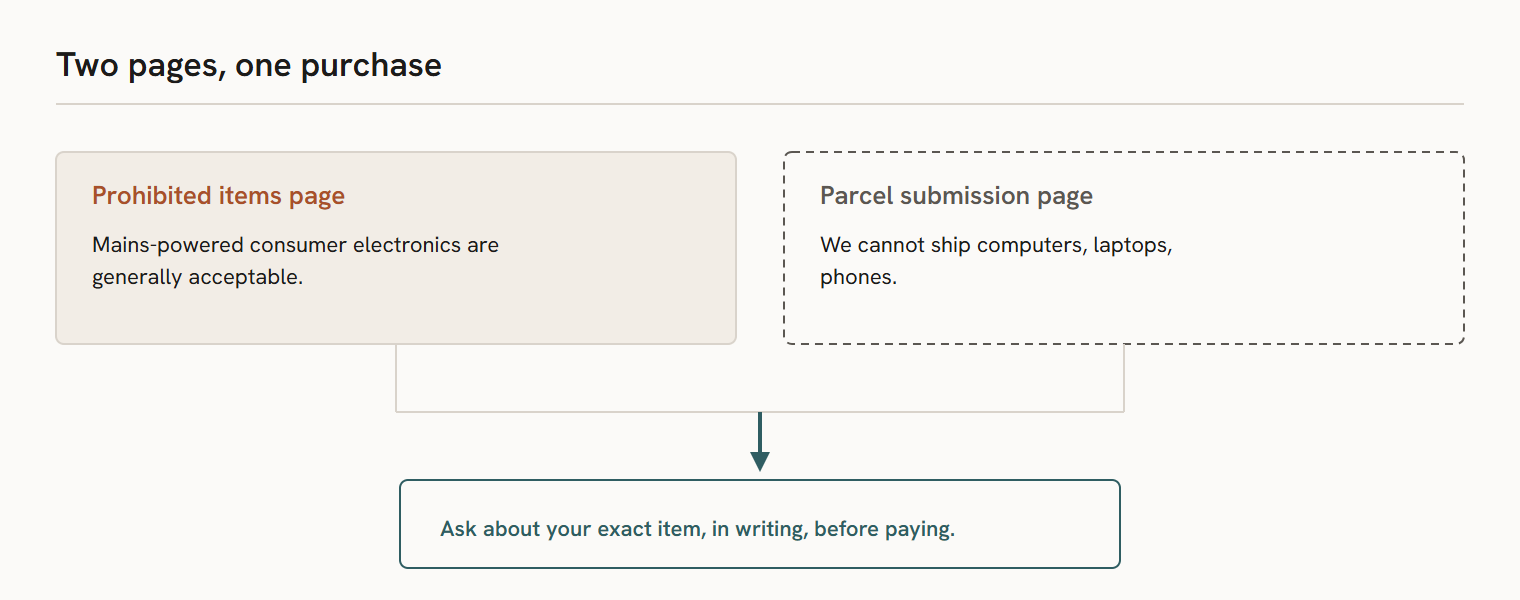
Plug-in powered consumer electronics are generally acceptable for shipping. However you must ensure the product does not contain lithium ion or lithium metal batteries as those are restricted from individuals tendering in shipments to the carriers.
Prohibited items, checked October 2026
What that leaves you with
One page treats mains-powered electronics as shippable; the other refuses computers, laptops and phones outright. Ask before you pay, and ask about your exact item.
Branded goods and counterfeits
What the page says
Counterfeit, bootlegged or pirated items [...] The US government protects company brands and their products by making it illegal to sell, trade, or ship counterfeit or otherwise infringing knockoff items.
Prohibited items, checked October 2026
What that leaves you with
Basetao treats these as two different things: a branded item is a rating input that can change your quote and your route, while a counterfeit is on the prohibited list. Which of the two you are holding is yours to establish before you pay.
How to use a contradiction
Quote both pages back to support and ask about your specific item, in writing, before you pay. An answer that only addresses the friendlier page is not an answer. This is also the honest reading of the word in this site's own domain: a branded item is a rating input on the official calculator, and a counterfeit is on the prohibited list. They are two different purchases with two different outcomes, and which one you are making is established by the listing, not by the category you found it in.
Work it out
Sorting one purchase into the three ends
Shipping check
Pick what you are buying and what it is made of. The answer tells you which of the three parties would stop it, and what is left for you to confirm yourself.
The table below carries the same rules, so this page works without scripts too.
| Applies to | Decided by | Outcome | Why |
|---|---|---|---|
| Brands | CN China export side | Depends on the item | Branded goods are one of the eight attributes the official calculator asks about, so declaring one can change your quote and your route. |
| Liquid | CA Carrier | Will not ship | Liquids are named in the forwarding page's refusal list. |
| Cosmetics | CA Carrier | Depends on the item | Cosmetics are a declared attribute. Many cosmetics are also liquids, which is the part that gets parcels refused. |
| Food | CN China export side | Depends on the item | Perishable foodstuffs are prohibited outright. Non-perishable food must arrive sealed and labelled, and the prohibited page requires the product name, an ingredient list in English and nutrition facts in English. |
| Magnetic | CA Carrier | Depends on the item | Magnets are one of the eight declared attributes. Basetao asks about it and does not publish what the answer changes. |
| Watches | CA Carrier | Depends on the item | Watches are a declared attribute. Most contain a battery, which is the part with a published rule. |
| Battery | CA Carrier | Depends on the item | Loose batteries are refused by the forwarding page. The prohibited page separately treats lithium ion and lithium metal batteries inside equipment as restricted. |
| Powder | CA Carrier | Will not ship | Powder is named in the forwarding page's refusal list. |
| electronics (category) | CA Carrier | Depends on the item | The two recorded official pages describe different restrictions. The forwarding page refuses computers, laptops and phones outright, while the prohibited page treats mains-powered consumer electronics as generally acceptable provided there is no lithium battery. |
| perfume (category) | CA Carrier | Will not ship | Perfume is a liquid, and liquids are named in the forwarding page's refusal list. |
Practical
A short checklist for each stage
Before you pay
- Screenshot the listing, including the options you picked. The inspection records model and version number, which is only useful if you can say what you expected.
- Ask about anything on either refusal list in writing, naming your item rather than its category.
- If it is a liquid, a powder, or a loose battery, assume no until told otherwise by support.
Before you ship
- Work out the volumetric weight yourself before choosing a line. Length by width by height in centimetres, divided by 5000.
- Check nothing in the parcel is over 1.5 m, including packaging.
- Decide on insurance while you still can: 2% and 4% of declared value buy different payouts, and the difference matters most for loss and customs seizure.
Choose a parcel, then follow its tracking
Select the warehouse items you want to send and confirm their QC decisions first. Enter the delivery address carefully, request suitable protection or packaging changes, and compare available routes using the packed weight and dimensions. Confirm content restrictions, total price, tracking and claim conditions before paying.
Once dispatched, save the tracking number and carrier shown in the parcel record. If tracking stops, ask which carrier has the parcel and when an investigation can be requested. At delivery, photograph damage, retain packaging and match the contents to the selected orders; send any discrepancy to support promptly with the parcel ID and evidence.